
In many fields of study, certain numbers have special functions. In mathematics, you will find the number pi for example, which plays a special role in calculating measurements of circles. In football, the number eleven is, of course, an important concept; in arithmetic, the number ten is central, since we use a base-10 arithmetic system. When you write sonnets, you will have the number 14 in mind; computer scientists consider 0 and 1 as an important pair of numbers. When you play the piano, the number 12 is important, since the piano is divided into groups of 12 notes.
For composers, 3 and 4 are important numbers, and in different ways for that matter. Firstly, most compositions in Western music are in 4/4 time. And the time signature that comes second in popularity is 3/4. In composition, four is an important number when it comes to the number of bars of a composition. As far as I can tell, Bach usually used an even number of bars in his pieces, and also usually a multiple of four. Somehow, it seems that an even number of bars gives the listener a feeling of comfort. In any case, the listener is more likely to experience a piece ending on an even bar as a credible conclusion, than one placed on an odd bar. As a composer, you can then play with this concept, as Paul McCartney does in the song “Yesterday”: he starts the song with a verse consisting of an odd number of bars (7). The effect on the listener is that the tension hasn’t truly released yet, and therefore you listen on to eventually feel that release later on. Note below how, after the intro, the verse consists of seven bars; very unusual.
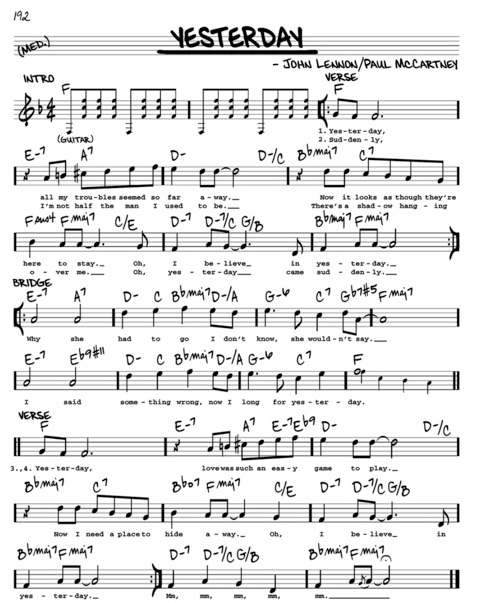
But there’s another important role for the pair 3 and 4, and I’ll explain that in my next vlog. We’re talking about the sum: 3 + 1 = 4. So very basic mathematics, don’t fret. Even the the hopeless math-flunker can do this!
See here:
*** GET YOUR MlKE”S PlANOBOOKS on mikespianobooks.com ***